

2026 Health Survey
Our Sister Group, Ladera Health Watch is informally gathering confidential, community-reported health information, including cancer diagnoses and other significant health conditions. This survey takes about 5–10 minutes to complete, depending on how much information you have available.This survey does not imply causation or assume any connection between health conditions and environmental factors. Its purpose is simply to help organize community-reported information and better understand whether any patterns may exist.Thank you for taking a few minutes to participate.


Understand the issues, misconceptions and potential solutions in order to take action in your community and at home.


As a resident grassroots organization, we encourage residents to download and make Signs/T-shirts etc to share awareness.

Help us show HOA leadership that support comes directly from Ladera Ranch residents.
Add your name and address to our confidential registry.
This conversation has grown following concerns about pesticide use in our common areas, reports of several pediatric Ewing sarcoma cases within Ladera Ranch, and increasing public interest in healthier approaches to landscape management.
We are not claiming that pesticides caused any specific illness. However, we believe these concerns deserve thoughtful discussion, transparency, and a careful look at whether there are better ways to care for our shared spaces.
Our goal is not simply to reduce pesticide use.
Our goal is to encourage a prevention first approach to landscape management that keeps Ladera Ranch beautiful while reducing the need for pesticides whenever possible.
We believe the conversation should focus not only on the products being applied, but on the overall system used to care for our landscapes.

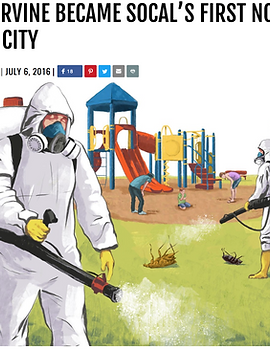
HOW IRVINE BECAME SOCAL'S FIRST NON-TOXIC CITY >>
Article by OC Weekly. July 6, 2016
"Laurie Thompson and her husband were leaving a Boston store while visiting family the night before Christmas Eve, 2014, when they spotted a solicitor for St. Jude Children’s Research Hospital..."
PESTICIDES AND CHILDREN DONT MIX >>
Children are especially vulnerable to pesticides. The National Academy of Sciences reports that children are more susceptible to chemicals than adults and estimates that 50% of lifetime pesticide exposure occurs during the first five years of life.
Article by BeyondPesticides.org
